Category: BCP

  • Google Merchant Center: The Free Google Shopping Visibility Most Kenyan BCP Businesses Skip

    Google Merchant Center: The Free Google Shopping Visibility Most Kenyan BCP Businesses Skip

    Google Merchant Center: The Free Google Shopping Visibility Most Kenyan BCP Businesses Skip

    Businesses, Companies & Production (BCP) · Process & Education

    60bn+products live in Google’s Shopping Graph as of mid-2026
    +50%more clicks when free listings run alongside paid ads

    Say “Google Shopping” to most Kenyan BCP business owners — feed manufacturers, auto parts dealers, packaging suppliers, distributors of every kind — and the reaction is almost always the same:

    “That’s for big online stores. We don’t run an e-commerce site.”

    It’s an understandable assumption. It’s also wrong, and it’s quietly costing product-based businesses across Kenya visibility they could be getting for free. The tool behind Google Shopping — Google Merchant Center — doesn’t require a shopping cart, doesn’t require online checkout, and in its most basic form, doesn’t cost a single shilling to use.

    If your business sells physical products, this is one of the highest-leverage, lowest-cost visibility moves available right now — and almost nobody in the BCP space is using it properly.
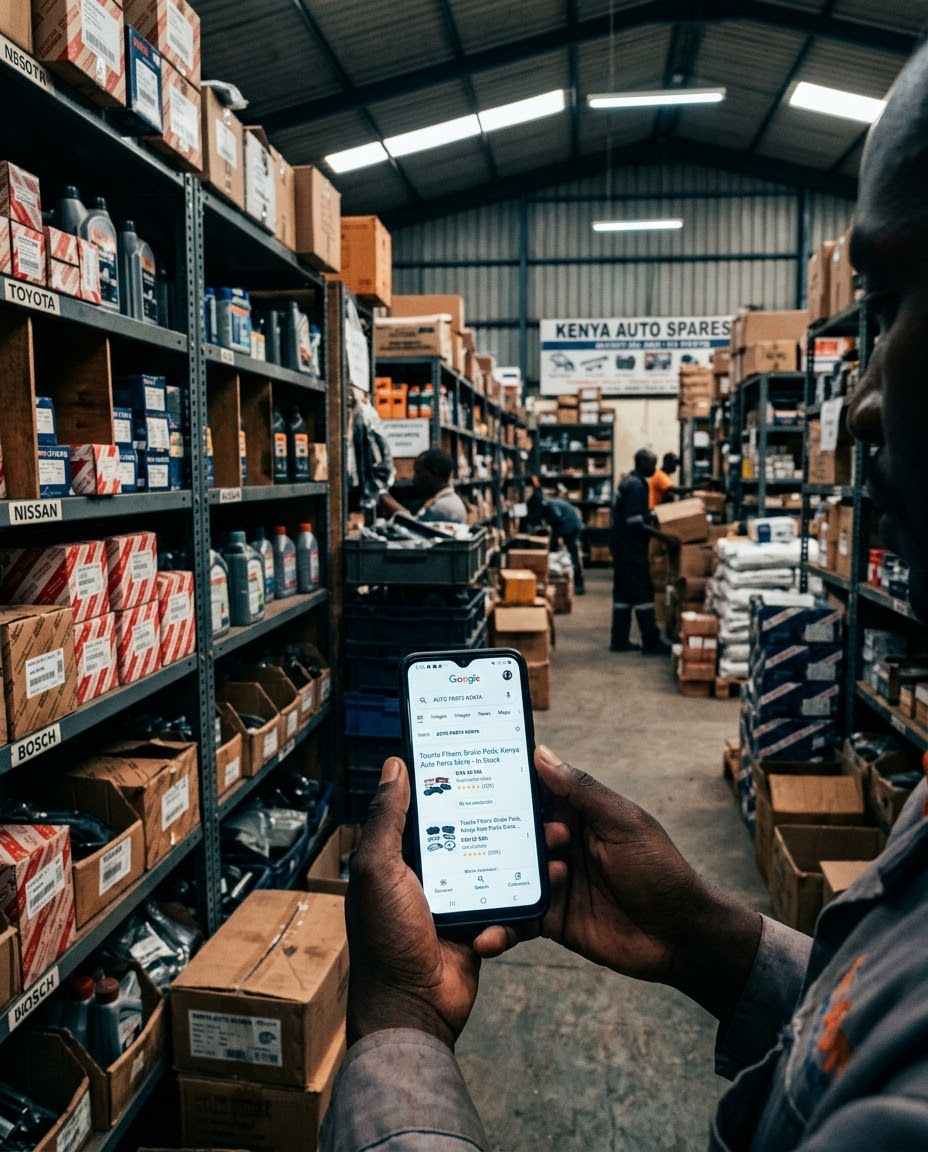
    Product catalogue feeding into Google Shopping search results

    What Google Merchant Center Actually Is

    Definition Google Merchant Center is a free platform where businesses submit a structured product feed — a file listing every product with its title, price, availability, and images — that Google uses to power both Google Shopping ads and, critically, free product listings that appear organically across Google Search, the Shopping tab, Google Images, Google Maps, and Google Lens.

    That second part is the piece most Kenyan BCP owners have never heard: Google’s free listings program lets your products appear with photos, pricing, and availability directly in search results — with no ad spend required. Free listings and paid Shopping ads draw from the exact same product feed; the feed is the foundation either way.

    The Standard Assumption vs. the Real Opportunity

    Standard assumption: “Google Shopping is a paid advertising channel for online retailers with e-commerce checkout.”

    Real opportunity: a Merchant Center account with an approved product feed and free listings enabled gets your products showing up — for free — the moment someone searches for what you sell. According to Google Merchant Center’s own program structure, a merchant who creates an account, submits a complete product feed, and enables free listings has spent nothing at all. The cost only appears once you choose to layer paid Shopping campaigns on top.

    $0 spendis required to get your products into Google’s free Shopping tab, Search results, and Google Images listings — the entry point most Kenyan BCP businesses assume doesn’t exist.

    For a Kenyan animal feed manufacturer or auto parts distributor, this means a potential customer searching “dairy meal supplier Kenya” or “Toyota shock absorbers Thika” can see your actual product, price, and photo directly in Google — without you spending a shilling on ads, and without needing a full online store.

    How the Product Feed Works

    The feed is simply a structured file — usually a spreadsheet or automated export — containing one row per product with required fields: title, price, availability, condition, images, and a product identifier. Google’s own product data specification defines exactly what’s needed, and feed quality directly determines whether — and how often — your products get shown.

    What tends to trip businesses up

    • Incomplete or stale data — outdated prices or “out of stock” items left live cause disapprovals or, worse, lost customer trust
    • Weak product titles — generic names instead of the specific terms a buyer would actually search
    • Low-quality images — Google recommends product photos of at least 1,500×1,500 pixels; blurry or watermarked images hurt eligibility
    • Missing shipping or availability details — Google favors listings that clearly state whether a product is in stock and how it’s fulfilled
    1,500×1,500pxis Google’s recommended minimum image size for product listings — a detail most self-managed feeds get wrong first time.

    Free Listings vs. Paid Shopping Ads

    These are two layers of the same system, not competing options:

    • Free listings — organic, unpaid placements in the Shopping tab, Google Images, and Search, ranked by relevance to the search query
    • Paid Shopping ads (via Google Ads) — priority placement in the prominent carousel at the top of search results, charged per click

    Both draw from the same Merchant Center feed. Businesses don’t have to choose one or the other — Google’s own data shows that merchants running free listings alongside paid ads see roughly 50% more clicks and double the impressions compared to paid ads alone.
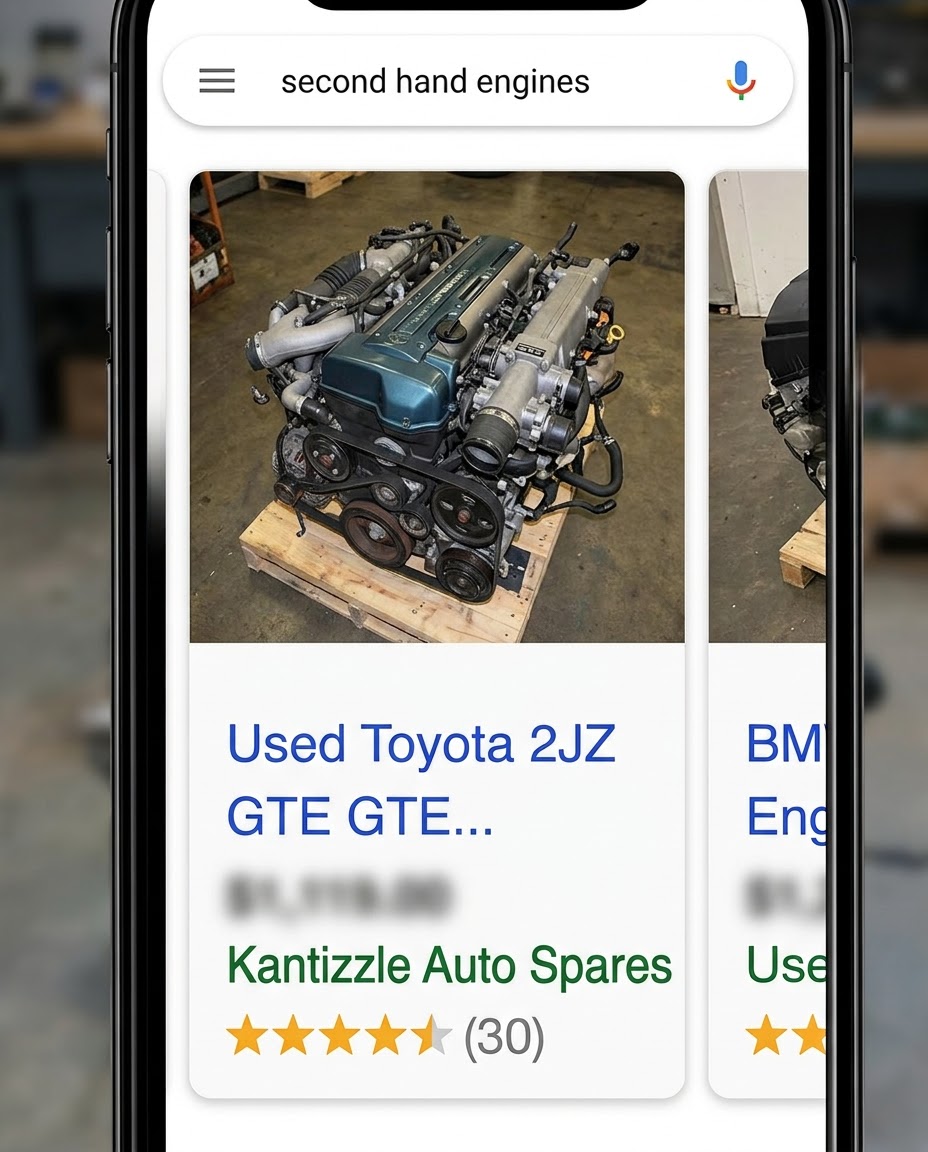
    The businesses treating Merchant Center as “something for later once we build an online store” are leaving free, immediate visibility on the table right now — visibility their competitors could be claiming instead.
    Kenyan warehouse or retail storeroom with smartphone showing Google product listings

    What This Looks Like for a Kenyan BCP Business

    You don’t need a checkout system to benefit. A feed manufacturer, packaging supplier, or auto parts retailer can submit a product feed listing their catalogue with accurate pricing and “in stock at our location” availability — directing the shopper not to an online payment page, but to a WhatsApp inquiry or a visit, tying directly back into the O2O approach we covered in our last article. The product shows up in Google. The transaction still happens the way it always has — by phone, WhatsApp, or in person.

    2bn+product listings inside Google’s Shopping Graph are refreshed every single hour — a scale most Kenyan BCP businesses aren’t yet visible inside at all.

    Getting Started: What’s Actually Required

    1. Create a Merchant Center account and verify ownership of your business website
    2. Build a primary product feed — even a well-structured spreadsheet works as a starting point
    3. Confirm free listings are enabled — this is on by default for new accounts, but worth checking under Marketing methods
    4. Keep pricing and availability current — stale data is the single biggest cause of disapproved or suppressed listings
    5. Layer in paid Shopping campaigns later — once the feed is clean and free listings are performing, paid placement becomes a scaling decision, not a starting requirement

    How Hamid Focus Builds This In

    For BCP Growth clients with physical product catalogues, Hamid Focus sets up a clean, properly structured Merchant Center feed alongside the core website build — so your products are eligible for free Google visibility from day one, not as an afterthought months later. Paired with the Focus Dashboard, you can see exactly which products are generating impressions and inquiries, and make an informed call on when paid Shopping campaigns are worth adding.

    Have a product catalogue sitting invisible on Google?

    See BCP Growth Pricing & Process

    Frequently Asked Questions

    Do I need an online store to use Google Merchant Center?

    No. A website with clear product pages, pricing, and contact details is enough. Free listings send interested customers to inquire by WhatsApp, phone, or in-person visit rather than requiring online checkout.

    Is Google Merchant Center really free?

    Yes, for the core function. Creating an account, submitting a product feed, and enabling free listings costs nothing. Costs only apply once you link a Google Ads account and run paid Shopping campaigns on top.

    How is this different from just having a Google Business Profile?

    A Google Business Profile shows your business location and details for local search. Merchant Center specifically shows individual products — with photos and prices — inside Google’s Shopping surfaces. The two work well together but serve different purposes.

    What’s the most common reason listings get rejected?

    Incomplete or inaccurate product data — missing images, outdated prices, or unclear availability — is the most frequent cause of disapproval. Keeping the feed current solves most issues.

    Should a BCP business start with free listings or paid ads?

    Free listings first. They cost nothing, establish which products get traction, and give you real performance data to decide whether paid Shopping campaigns are worth the investment later.

  • O2O Marketing in Kenya: Why Your Online Presence Should Be Selling In-Store, Not Just Online

    O2O Marketing in Kenya: Why Your Online Presence Should Be Selling In-Store, Not Just Online

    Businesses, Companies & Production (BCP) · Process & Education

    O2O Marketing in Kenya: Why Your Online Presence Should Be Selling In-Store, Not Just Online

    97%of Kenyan internet users are on WhatsApp — highest in Africa
    60–70%of shoppers research online and offline before buying
    ← swipe for more stats →

    Ask a business owner almost anywhere in Kenya — Thika, Nakuru, Eldoret, Kisumu, it doesn’t matter — why they haven’t invested in a proper website or social presence, and you’ll usually hear some version of the same line:

    “I don’t sell online, so I don’t need it.”

    It’s a reasonable-sounding assumption. It’s also, quite possibly, the single most expensive mistake a Businesses, Companies & Production (BCP) operator can make in 2026 — whether that business sits on a busy Thika highway frontage or a quiet trading centre off the main road.

    Here’s the part that gets missed: your customer has already searched for you before you know they exist. They’ve checked your Google listing, scrolled your Facebook page, or asked a friend to forward your WhatsApp number — and they did all of it on a smartphone, before ever walking through your door. The business that shows up well in that moment gets the sale. The one that doesn’t loses it to a competitor who does, even if that competitor’s product is objectively worse.

    This is what’s known as O2O marketing — and across Kenya, from major towns to smaller trading hubs, the opportunity behind it is bigger than most owners realize.

    Online-to-offline customer journey from smartphone search to in-store visit

    What O2O Actually Means

    Definition O2O — online-to-offline — is a strategy that uses digital channels to bring customers into a physical location or into a direct offline transaction, rather than trying to complete the sale entirely on a website. It is not the same as e-commerce, where the transaction happens end-to-end online, and it’s not the same as generic brand awareness marketing, which has no specific offline action as its goal. O2O has one job: turn a person scrolling their phone into a person walking into your shop, calling your line, or sending a WhatsApp order.

    For manufacturers, distributors, wholesalers, and service providers — the core of the BCP vertical, wherever in Kenya they operate — this is almost always the more realistic and more profitable model than trying to build a full online store from scratch.

    Why This Is a Bigger Opportunity in Kenya Than Most Owners Realize

    Three shifts have quietly changed the math for BCP businesses nationwide over the past two years, and most owners haven’t caught up with what they mean commercially.

    1. The “online” half of O2O is already sitting in every customer’s pocket

    Kenya’s smartphone penetration has climbed sharply nationwide. According to recent Communications Authority figures, smartphones now account for roughly 93 out of every 100 mobile devices connected to local networks, and mobile internet access sits at near-universal levels among smartphone owners across the country. The old objection — “my customers aren’t online” — simply doesn’t hold anymore, whether your customer base is in a major city or a smaller regional town.

    80.8%+of Kenya’s total mobile connections are smartphones, per the Communications Authority of Kenya — and that share keeps rising every quarter.

    2. WhatsApp closes the gap between discovery and inquiry

    Kenya has one of the highest WhatsApp penetration rates on the continent, at around 97% of internet users — the highest of any African market. That matters because WhatsApp Business is the cheapest, fastest bridge between “found your business online” and “spoke to a real person about buying.” A visitor who lands on your Google listing or social page and can tap straight into a WhatsApp chat converts at a completely different rate than one who has to hunt for a landline number or fill out a slow contact form.

    3. Mobile money removed the last friction point

    Mobile money penetration in Kenya now covers nearly the entire adult mobile user base, at close to 98%. The step between “I’ve decided to buy” and “payment is done” has effectively disappeared, nationwide. The instant-gratification appeal that drives shoppers into physical stores — being able to see, negotiate, and walk away with the product immediately — is fully intact in Kenya, and it’s backed by frictionless payment infrastructure that few other markets can match.

    98%mobile money penetration means almost every adult customer in Kenya can complete a transaction the moment they walk in — no separate “online payment step” required.
    The businesses winning right now aren’t the ones with the flashiest websites. They’re the ones whose online presence makes it effortless to take the next offline step — a call, a WhatsApp message, a visit.

    The Standard Assumption vs. the Real Opportunity

    Standard assumption: “Digital marketing is for businesses that sell online.”

    Real opportunity: digital marketing’s actual job for a BCP business is to generate qualified foot traffic, phone calls, and WhatsApp inquiries — not online checkouts. Research from McKinsey & Company, cited by Anchanto, found that 60–70% of shoppers use both online and offline channels while researching a purchase. That means the business that’s easiest to find, verify, and message online has already won half the sale before the customer ever shows up in person — a dynamic that plays out the same whether the buyer is in Nairobi’s industrial area or a county trading centre two hours away.

    63%of shoppers start their buying journey online, per BigCommerce — even when they intend to complete the purchase in a physical location.

    An animal feed distributor doesn’t need a shopping cart. They need a Google Business Profile that shows up when someone searches “animal feed supplier near me,” a website that states stock, pricing tiers, and delivery radius clearly, and a WhatsApp button that turns a curious visitor into a same-day inquiry. The same logic applies to an auto parts retailer, a packaging manufacturer, or a construction supplies wholesaler — different products, identical buying pattern.

    Kenyan business owner checking smartphone in shop or warehouse

    Common Mistakes Kenyan BCP Businesses Make with O2O

    • Treating the website as a brochure, not a bridge — a page that describes the business but gives the visitor no clear next offline step
    • Burying contact details — location, hours, and WhatsApp number should be visible within seconds, not buried on a separate “Contact Us” page
    • Ignoring Google reviews — trust signals matter more, not less, when the goal is getting someone to physically travel to you
    • Assuming rural or peri-urban customers aren’t online — with smartphone and mobile money penetration this high nationwide, that assumption is increasingly outdated everywhere in Kenya

    What O2O Looks Like in Practice for a Kenyan BCP Business

    • Local search visibility — a claimed, accurate, review-active Google Business Profile so you appear for “near me” searches
    • WhatsApp Business as the bridge — one tap from your website or social page straight into a conversation
    • Visible social proof — reviews and testimonials that build enough trust for someone to make the trip to your location
    • Zero-friction basics — clear hours, location, and contact details so nothing stands between “I found you” and “I visited you”

    How Hamid Focus Builds This In

    Every BCP Growth build at Hamid Focus is designed around O2O from the first page, not bolted on afterward. That means WhatsApp-first CTAs placed at natural decision points, Google Business Profile alignment, and a Focus Dashboard that shows you exactly which channel — search, social, or referral — is driving real inquiries, so you can see the online-to-offline bridge working in your own numbers. The full BCP Growth build is completed in 25 days, wherever in Kenya your business operates.

    Ready to turn your online visibility into walk-in customers?

    See BCP Growth Pricing & Process

    Frequently Asked Questions

    Is O2O marketing only for businesses that also sell online?

    No. O2O is built specifically for businesses whose sales happen offline. The goal isn’t to replace in-person transactions — it’s to use online visibility to generate more of them.

    How is O2O different from omnichannel marketing?

    Omnichannel marketing lets customers move freely between online and offline at any stage of the relationship. O2O is narrower and more deliberate: it specifically uses online channels to drive a single outcome — an offline visit, call, or transaction.

    Does O2O work outside Kenya’s major cities?

    Yes. Smartphone, WhatsApp, and mobile money penetration are all high nationwide, not just in Nairobi or other major urban centres, so the same O2O principles apply to businesses in smaller towns and trading centres.

    How do I know if my website is actually driving in-store visits?

    You track it. A Focus Dashboard setup shows which pages, searches, and social posts lead to WhatsApp inquiries or calls, so you can see the connection between your online presence and offline foot traffic instead of guessing.

    What’s the fastest way to start with O2O if I have no online presence at all?

    Start with a claimed and accurate Google Business Profile and a WhatsApp Business number, then build a website that makes both easy to find. That sequence alone captures most of the near-term opportunity.